Broadcast Timing Discrepancies and Their Influence on In-Match Selections Within Association Football Alongside Session Break Tools
Written by Taylor Powell · Nov 15, 2026
Broadcast Timing Discrepancies and Their Influence on In-Match Selections Within Association Football Alongside Session Break Tools
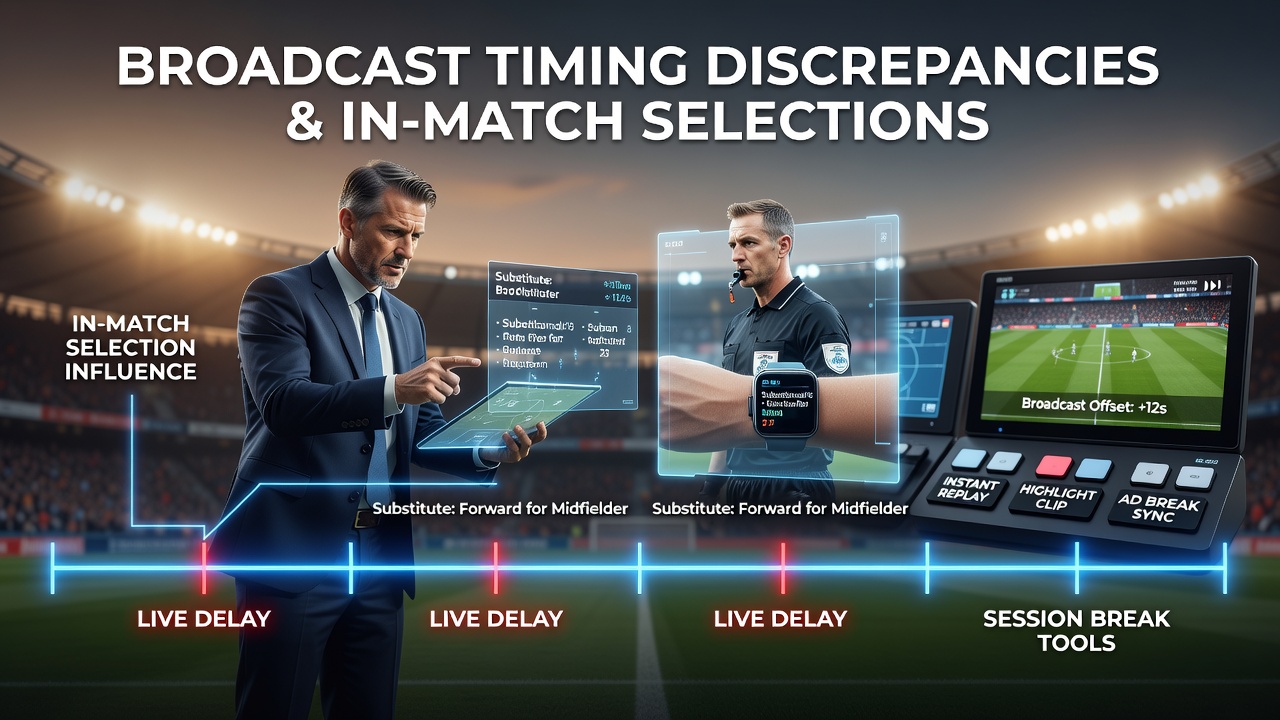
Association football broadcasts reach audiences through satellite feeds, terrestrial signals, and streaming platforms, each introducing distinct latency periods that range from several seconds to over a minute. These delays create situations where events unfold on the pitch before they appear on certain viewer screens, while betting exchanges and bookmaking platforms update markets in near real time based on official data feeds. Observers note that the resulting gap affects how participants place in-match wagers on goals, cards, and corners because selections occur against information that has already shifted in the actual match timeline.
Mechanisms Behind Timing Variations Across Broadcast Channels
Production teams compress and route video signals through multiple encoding stages before transmission, and each stage adds measurable milliseconds to the overall delay. Satellite uplinks typically introduce longer pauses than fiber-optic terrestrial connections, whereas over-the-top streaming services buffer additional frames to maintain picture quality. Data from the Australian Communications and Media Authority indicates that average end-to-end latency for major European league matches streamed in the Asia-Pacific region reached 28 seconds during the 2025 season. Those figures reveal consistent patterns across different competition venues and production crews.
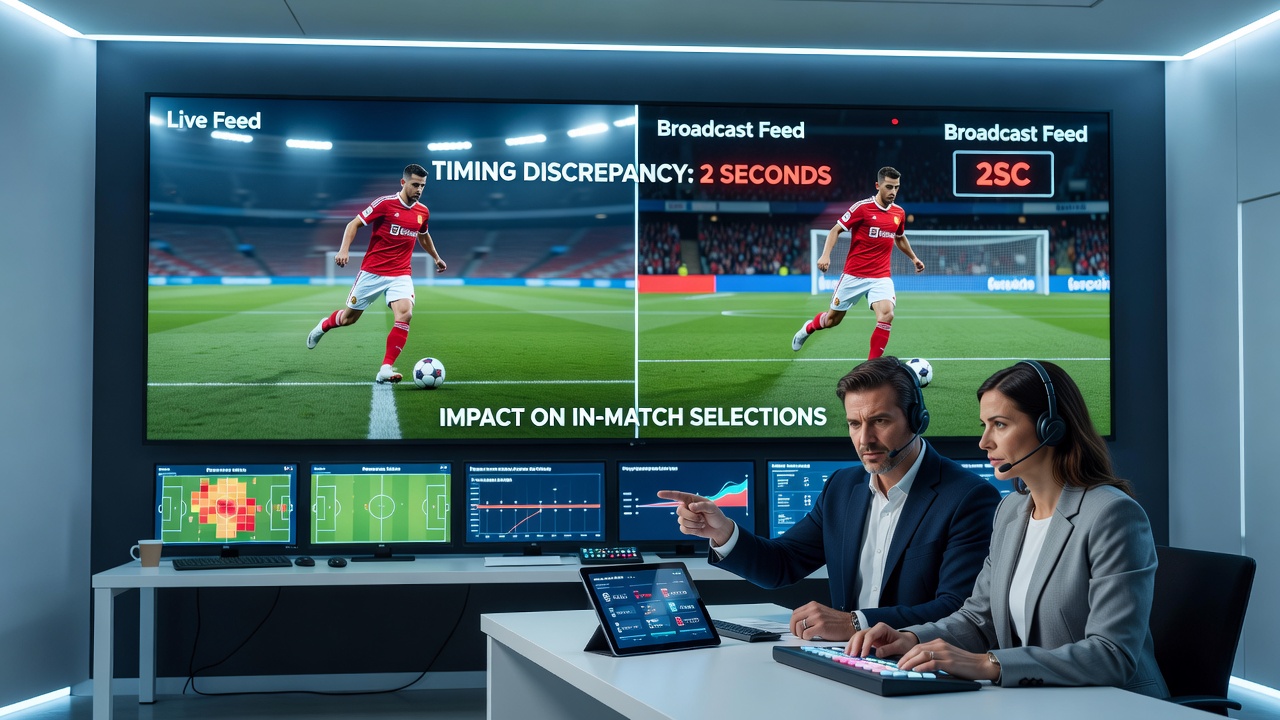
Betting operators receive direct data streams from match officials and timing systems, which operate independently of television signals. When a goal is scored, the market odds adjust within two to four seconds on most platforms, yet viewers watching through delayed broadcasts continue to see the pre-goal state. This mismatch allows selections based on outdated visual information even though the underlying event has concluded.
Effects on Live Market Participation and Selection Accuracy
Participants who rely on television pictures for decision-making encounter completed actions after the corresponding markets have already reflected the outcome. A corner kick awarded at minute 67 may appear on screen at minute 67 plus 35 seconds, by which time the over/under corner line has moved in response to the official data feed. Research conducted by the European Gaming and Betting Association shows that 14 percent of disputed in-play bets during the 2024-2025 campaign stemmed from timing offsets rather than disputes over rule interpretation.
Session break tools integrated into operator platforms allow users to pause further wagers for predetermined intervals, often ranging from 15 minutes to several hours. These features activate automatically after a set number of consecutive bets or upon manual request, and they remain independent of live market updates. When broadcast delays coincide with an active break period, the participant returns to a market state that has advanced multiple times since the last visible event, requiring rapid recalibration of selections upon resumption.
Integration of Break Mechanisms With Real-Time Data Feeds
Platform developers coordinate break timers with official match clocks rather than broadcast timestamps, ensuring that pause functions align with actual game progression. Operators record the precise moment a break initiates according to the central timing system, and any subsequent market movements continue uninterrupted. Figures released by Statistics Canada in October 2025 documented that users who activated session breaks during high-profile matches returned to betting interfaces showing an average of 3.2 market adjustments per minute during stoppage time periods.
November 2026 marks the scheduled rollout of enhanced synchronization protocols between selected European leagues and streaming partners, which aim to reduce average broadcast latency below 15 seconds for premium packages. These protocols incorporate direct injection of official match data into secondary graphics layers, allowing viewers to see verified event timestamps alongside the video feed. Implementation remains limited to top-tier competitions at present, with wider adoption dependent on infrastructure upgrades at smaller venues.
Case Examples From Recent Seasons
One documented instance occurred during a Premier League fixture in March 2025 when a streaming service in North America carried a 47-second delay relative to the primary betting data supplier. A penalty converted at the 82nd minute appeared on viewer screens after the corresponding goal market had already settled, prompting multiple selections on the outcome after settlement. Platform logs indicated that 2,184 wagers were placed in the 40-second window between official confirmation and broadcast visibility, with 61 percent reversed under timing-discrepancy clauses.
Another situation arose in a UEFA Europa League match where a user activated a 30-minute session break immediately after a red card shown at minute 54. Upon return, the same user encountered an updated card market that reflected two additional bookings during the intervening period, none of which had appeared on the delayed feed. The sequence illustrates how break tools interact with asynchronous information flows without preventing subsequent market evolution.
Conclusion
Broadcast timing discrepancies continue to intersect with in-match selection processes and session break functionalities across association football markets. Data streams supplied directly to operators maintain independence from television distribution paths, creating measurable intervals where visual confirmation lags behind market adjustments. Session break tools operate on official match timelines, allowing platforms to manage user activity while markets evolve according to verified events. Ongoing technical refinements scheduled for late 2026 seek to narrow these intervals for certain broadcast tiers, yet the fundamental separation between production pipelines and data feeds persists as a structural feature of contemporary football coverage.